


Friends — I hope you all had a restorative weekend. Ours here in the Shushan household was busy in a good way, thanks to Rosh Hashanah and a birthday in the family.
Rosh Hashanah services were thoughtful and nourishing, thanks in no small measure to our rabbi, Amelia Wolf, who was just featured in this Haaretz piece: “American Rabbis Confront a Fraught Question This High Holiday Season.” In case you’re wondering her answer to that ‘fraught question’ was, in part: “I think it’s to the detriment of our Jewish communities in the United States if we’re all about Israel.” ICYMI, Rav Amelia joined me for this episode of The Debrief in July that I highly recommend.
With the holiday and all, it’s taken a little longer than I’d like to get this podcast with Foundation for Middle East Peace President Lara Friedman (which aired live on Friday) out to you all. I promise it’s worth the wait!
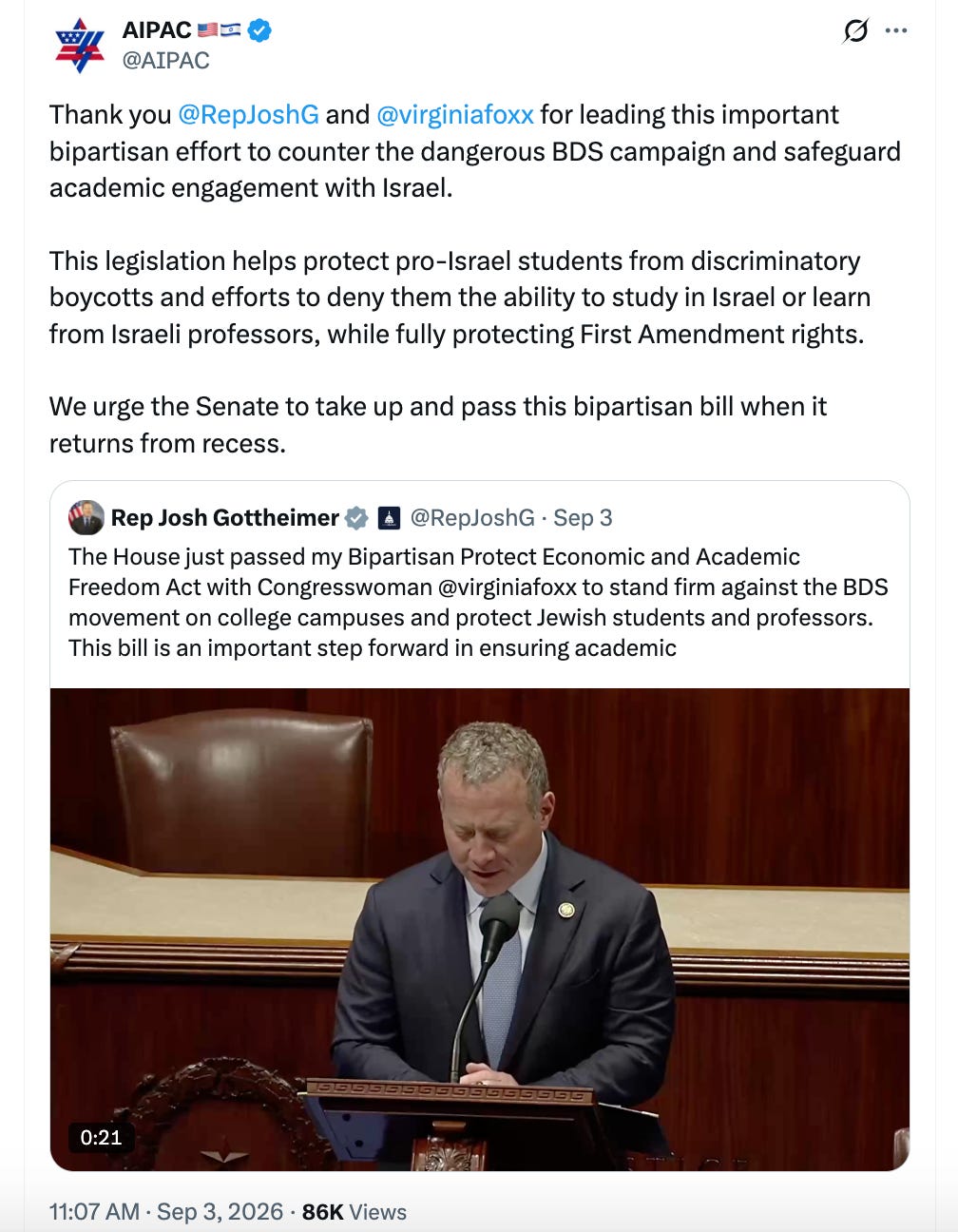
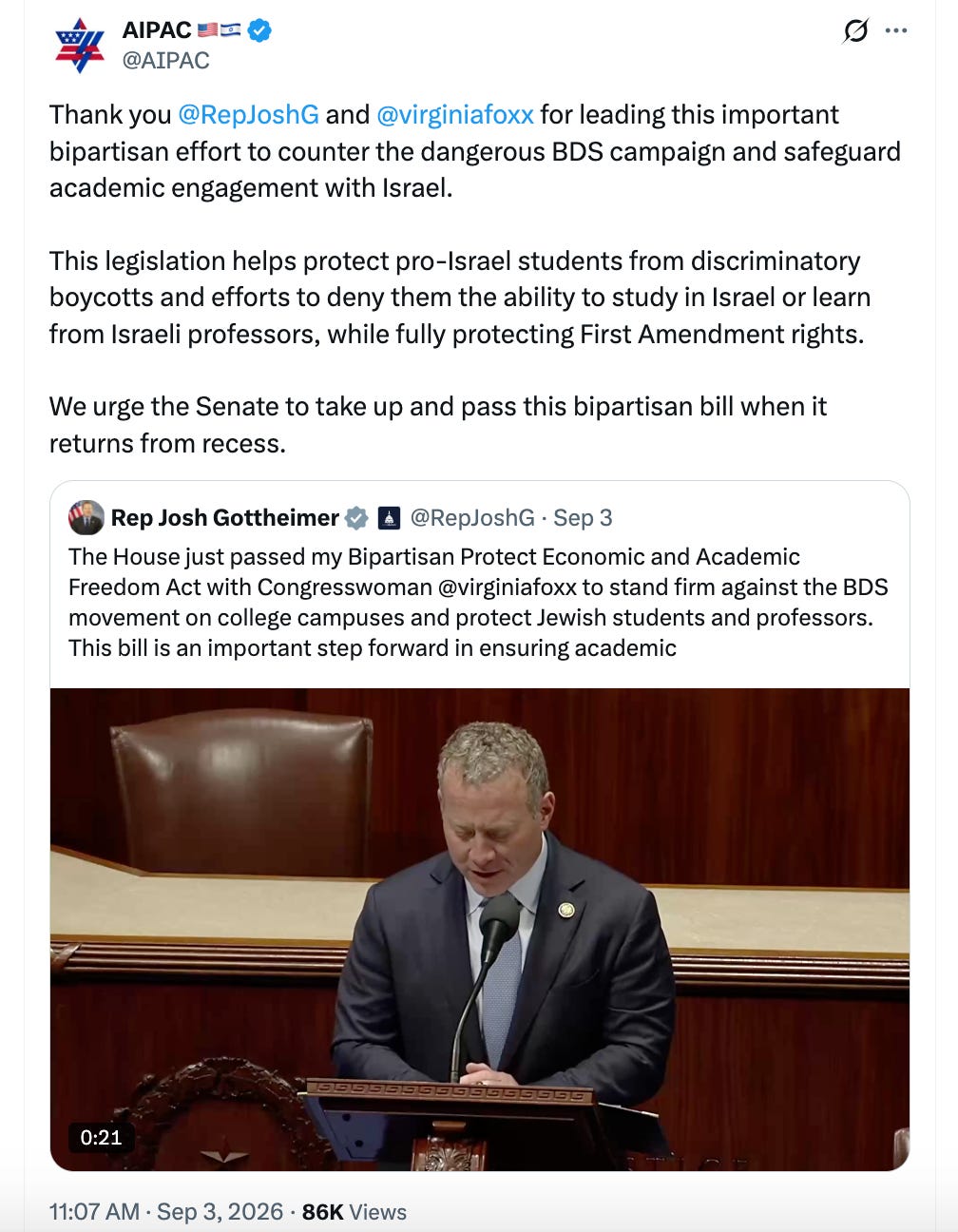
Much of podcast centers around the “Protect Economic and Academic Freedom Act” (H.R.4795), recently passed by the House. The topics we discussed included:
What the legislation does: It requires universities to engage in programming, conferences, exchanges, study abroad programs, etc. with Israeli institutions (including those in settlements) under the same conditions as they do with academic programs in other countries — or else lose their ability to receive certain federal funding. It appears to target pro-Palestine activism, though no university has adopted the BDS-related policies at which the bill takes aim
Assault on the right to boycott: While its supporters claim that the bill protects First Amendment rights, it violates the right to engage in economic boycotts (which it terms “non-expressive commercial boycotts”); the Supreme Court upheld boycotts as a constitutional right in NAACP v. Claiborne Hardware Co. Rep. Jerry Nadler called the H.R.4795 a “direct and gross violation of the First Amendment,” citing the ACLU’s opposition to the bill
Lawfare and the False Claims Act: The bill makes universities susceptible to private lawsuits that are likely to be politically motivated and are financially incentivized — with the lawyer receiving a payout for successful claims
Attack on higher education and pro-Palestine activism: H.R.4795 fits into the attacks against academia that began during the post-October 7th campus protests over Gaza and have exploded under the second Trump administration
Erasing the Green Line and treating settlements as part of Israel: H.R.4795 is not the first US law to treat the occupied West Bank as annexed territory, but it takes the additional leap of penalizing US colleges and universities for refusing to collaborate with Israeli educational institutions in West Bank settlements
Israel’s Lobby exemplified: Fresh off The Debrief’s podcast with Eli Clifton and Ian Lustick on their new book, I asked Lara whether H.R.4795 exemplifies the determination by what Clifton and Lustick term “Israel’s Lobby” to constrain civil society and limit discursive space around Israel:
I think it’s self-evidently true… They can’t win the argument about Israel on its merits, so they’re having to define everything as antisemitism… You’ve got the indefensible out there for the world to see and the stakes in defending it or at least shutting down criticism of it… is higher than ever…
This legislation, again, we’ve talked about this as part of a broader move, of really creating a new paradigm for universities of red lines you shall not cross. And if you do cross them, it’s existential for you as a university.
Politics and procedure that enabled H.R.4795 to pass in the House: While the bill received far more votes from Republicans than Democrats, it was introduced as a bipartisan effort by Reps. Virginia Foxx and Josh Gottheimer; all but two Republicans and 33 Democrats voted in favor; Democratic Reps. Gluesenkamp Perez and Golden helped Republicans pass a rule under which the bill could pass with a simple majority
How UK’s Israel-Palestine reset could trigger anti-BDS laws passed by most US states: Following Foreign Secretary Ed Milliband’s announcement of a ban on products from Israeli settlements, Arkansas Governor Sarah Huckabee Sanders stated, “Arkansas law makes clear that we won’t do business with any company that deliberately chooses to engage in BDS activities. Period.” The upshot? Arkansans and residents of other states with anti-BDS laws “are going to be human and economic shields for Israel against accountability,” in Lara’s words.
As always, I’m looking forward to your comments, folks!
I hope you value the deep insights that podcasts like this one with Lara Friedman bring you. Lara shared these parting words:
“Thank you for this podcast… It’s tremendous. Everyone should give it as a gift to your friends.”
So lovely!
If you agree with Lara, I hope you’ll become a paid subscriber, or gift The Debrief to a friend. Paid subscriptions sustain this work and help more people discover it. Check out the other opportunities to support, too. Restacking/sharing posts is also appreciated!
Coming Up This Week on The Debrief!
TOMORROW (Wed, Sept. 16) at 11:30am Eastern:
I’m joining our friend, Saudi dissident, analyst, and activist Wajeeh Lion on his podcast. Many of you already know and love Wajeeh. Come and hang out with us for another fascinating Middle East download.

Thursday, Sept. 17 at 12pm Eastern: OFFICE HOURS!
Don’t miss our next community gathering, where you have the opportunity to Ask Dr. Shushan Anything.
Office Hours are an exclusive benefit for paid subscribers — so this is a great time to upgrade!
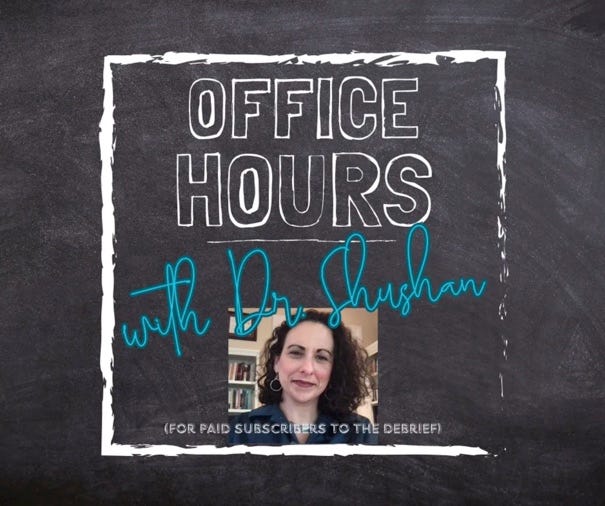
Please submit your questions in our subscriber chat or you can ask them live during Office Hours.

Friday, Sept. 18 at 1pm Eastern: Mo Husseini returns to The Debrief!

I’m thrilled to welcome Palestinian American writer, filmmaker, storyteller, and delightful human Mo Husseini to The Debrief! Mo’s latest Substack piece is entitled, “NAZA, or, On the Peculiar Credibility of War Criminals Who Look Like You.” The piece is Mo’s reaction to the Israeli film that has generated a firestorm of criticism in Israel by people who haven’t seen it, but are nonetheless calling for the filmmakers to have their citizenship stripped on charges of treason and fomenting antisemitism.
As with anything Mo writes, it’s worth reading.
We’ll discuss NAZA and reactions to it — but please be advised that, like Benjamin Netanyahu and top IDF brass, neither Mo nor I have seen the film.
I’m also eager to probe Mo’s thoughts on the upcoming elections in Israel and the US.
Join us!
That’s it for now, folks!
Looking forward to seeing many of you at our upcoming podcasts this week.
Warm regards,
Debra


